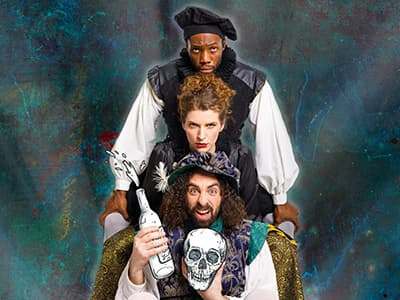
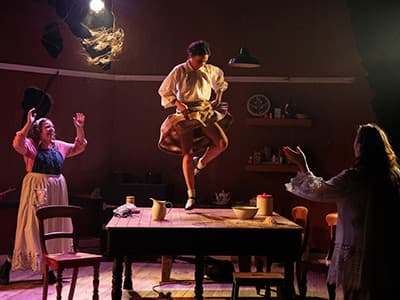
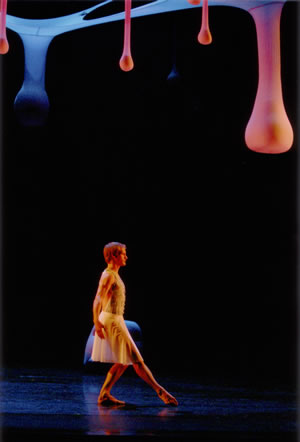
 Right - Daniel Squire. Cover - Merce Cunningham Dance Company in Views on Stage. Photos - Tony Dougherty
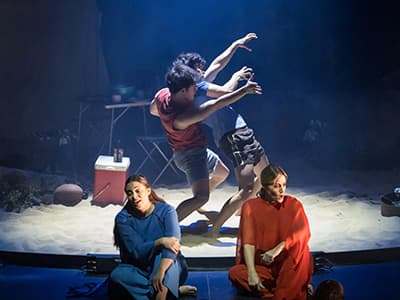
Intro - Merce Cunningham Dance Company in Split Sides
It was a double dose of the Merce Cunningham Dance Company for the die hard dance fans with a Program B directly on the heels of Program A, which had only closed the previous night.
While Program A was a mix of past and present Cunningham, with material ranging from 1956 through to 2006, Program B was firmly rooted in the very recent past. A double bill of dances from 2003 and 2004, it was a full evening of two substantial works, both of which the company executed with tireless precision and control.
Cunningham’s dance vocabulary is highly difficult to achieve well. It starts from a ballet base, but movements are shifted slightly off centre, or dropped low to the ground. There are many pauses, where precarious positions are held for several seconds and then transitioned into another equally difficult posture. There is so much to coordinate between upper and lower bodies, with the two section often doing stylistically different things at the same time.
View on Stage (2004) opened the program with a single man in a white skirt. Building into various solos and then larger sections, much of the vocabulary was variations on ballet poses such as developpe, fondue and arabesque, but often with bent elbows held towards waist or up in the air. It built a circularity of pattern, slightly echoing the nebulous white hanging set by Ernesto Neto. Like bubbling blobs inside a lava lamp, long rounded shapes hung from a canopy, creating an other worldly sensation. John Cage’s music worked both at odds and in harmony with the movement.
It was the second half of the program where the audience got a sense of some of Cunningham’s chance procedures for creating his dances. Cunningham invited five people onto stage to roll a die and determine the order of Split Sides (2003) in terms of choreography, costume, music, set, décor and lighting. The outcome of the roll dictated which of the two choices for each element came first and second. There are many possible combinations. We got the black and white costumes first and then the colourful ones. We heard Sigur Ros’s music followed by Radiohead.
Even though it was essentially two pieces, Split Sides felt like a cohesive whole. The movement was relentless and complex, much faster and intricate than View on Stage and equally athletic, but in a different way. Starting and ending with dancers in silhouette (somehow the lighting cues were synched to make this happen), created a continuity to proceedings. The determination of the order and combination of design elements before performance gave the audience a role, albeit small, in the dance making process.
Cunningham’s work is challenging for audiences. He certainly does not spoon feed viewers. His contributions to the development of performance over the last 50 years - forsaking the dance “narrative” for abstraction, the idea that music and dance can be created independently and the use of chance procedures to create dance works (to name a few) have influenced and continue to influence so many artists.
Full credit to Kristy Edmunds and MIAF for bringing such an extensive Cunningham residency to Melbourne and allowing us to experience first hand a period and a style of art making that has shaped contemporary art practice around the world.
Melbourne International Arts Festival present
Program B: Views on Stage (2004) / Split Sides (2003)
Merce Cunningham
Venue: the Arts Centre, State Theatre
When: Fri 26 & Sat 27 Oct at 7.30pm
Duration: 1hr 25min with interval
Prices: Premium $84.50 / A Reserve Full $65 / A Reserve Groups (8+) $58.50 / A Reserve Conc $48.75
B Reserve Full $52 / B Reserve Conc $39 / B Reserve Student $22
C Reserve Full $36 / C Reserve Conc $27 / C Reserve Student $22 / School Groups $12
Bookings: Ticketmaster 1300 136 166 | www.melbournefestival.com.au